Why Non-Basmati Rice Continues to Dominate Food Supply Chains in Gulf Countries
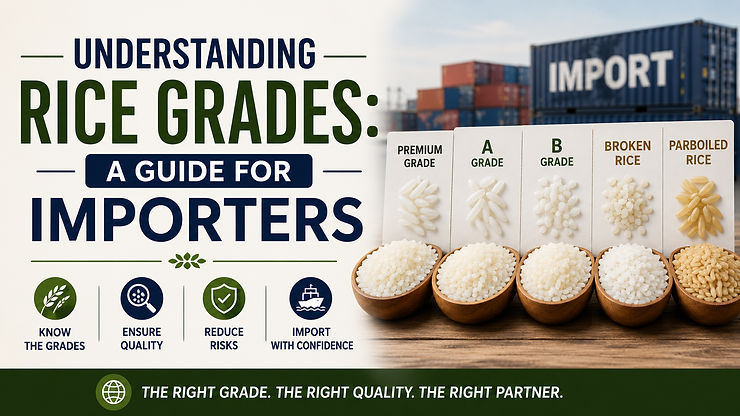
The Gulf is one of the world's most sophisticated rice import markets. Understanding why non-basmati leads here tells you everything about how large-scale food procurement actually works.
The Direct Answer
Non-basmati rice dominates Gulf food supply chains because it delivers what large-scale operations require: consistent volume, predictable cooking behaviour, strong cost efficiency, and proven regulatory compliance across UAE, Saudi Arabia, Kuwait, Qatar, Oman, and Bahrain. While basmati commands premium positioning in retail and fine dining, non-basmati drives the daily volume that feeds millions across hotel chains, institutional catering, labour accommodations, school meal programmes, and government food reserves.
This is not a compromise. It is a deliberate, informed procurement decision made by some of the most experienced food importers in the world.
The Gulf Rice Market: Scale That Changes Everything
The six GCC countries collectively import millions of metric tonnes of rice every year. The numbers are staggering when you consider that the Gulf grows almost none of its own rice every grain consumed is imported, and the infrastructure that moves it from field to fork is one of the most developed commodity trade ecosystems in the world.
Within that system, non-basmati rice particularly long-grain white varieties handles the volume that basmati simply cannot match at the price points required for institutional feeding. A hospital in Riyadh feeding three thousand patients a day, a labour camp in Abu Dhabi catering to ten thousand workers, a school nutrition programme running across forty campuses these operations cannot be built around premium aromatic rice. They require consistent, affordable, shelf-stable grain in quantities that arrive reliably, month after month.
Non-basmati delivers that. And Indian non-basmati, in particular, has become the backbone of Gulf food supply for reasons that go deeper than price alone.
Why Indian Non-Basmati Rice Specifically
India has built an export infrastructure for non-basmati rice that no other country has matched at scale. Processing capacity, port logistics, documentation systems, and the sheer variety of grades available from fully milled to parboiled, from 5% broken to 25% broken give Gulf importers a level of specification control that serves every segment of their market simultaneously.
One specification that has become a staple in Gulf institutional supply chains is long grain white rice 25% broken. This grade sits at a price point that serves high-volume, cost-sensitive operations without sacrificing the cooking consistency that large kitchen teams depend on. It absorbs seasoning evenly, cooks predictably across large batches, and holds texture through the service periods that institutional catering demands. For procurement managers running Gulf food operations at scale, this specification is not a fallback it is a professional choice backed by operational experience.
Four Reasons Non-Basmati Stays Dominant in the Gulf
1. Volume Reliability That Basmati Cannot Match
The Gulf's dependence on imported food means supply chain resilience is a procurement priority, not a secondary concern. Non-basmati rice produced across a wider growing geography and in greater aggregate volume than basmati offers more supply-side flexibility during crop variation years. Basmati, grown only in the specific regions of northern India and Pakistan, is more vulnerable to seasonal disruption and geographic concentration risk.
For a Gulf government managing a strategic food reserve, or a large hotel group planning six months of purchasing forward, the supply depth of Indian non-basmati is a genuine operational advantage.
2. Regulatory Clearance Is Established and Repeatable
Gulf countries have precise import standards pesticide residue limits, moisture thresholds, milling specifications, and labelling requirements. Established Indian exporters who have been shipping non-basmati to the GCC for years have already built compliance systems around these standards. Their documentation packages are clean, their test reports are routine, and their port clearance record is proven.
This matters enormously to Gulf importers, where a delayed or rejected shipment can cascade into operational disruption across multiple sites. Repeatability is worth more than marginal price savings from an untested source.
3. Culinary Fit Across the Region's Diverse Population
The Gulf's population is among the most ethnically diverse in the world. South Asian, Southeast Asian, East African, and Arab communities each with distinct rice preferences coexist within a single food service operation. Non-basmati varieties span this range: IR64 parboiled serves South Asian and East African preferences, long-grain white serves Arab and Levantine preparations, and broken-grade rice serves institutional cooking at the highest volumes.
This variety-within-category flexibility is something the basmati segment, with its narrower culinary application, cannot replicate. As explored in our analysis of why restaurant chains prefer non-basmati rice for large-scale operations, the professional kitchen logic that drives chain-level procurement applies equally to Gulf institutional supply.
4. Price Stability Enables Long-Term Contract Planning
Gulf food operators particularly those managing government contracts or hotel management agreements work on multi-year pricing structures. Non-basmati rice offers greater price predictability than premium basmati, whose market price fluctuates significantly with harvest quality, export policy, and aromatic compound testing outcomes.
Building a sustainable food cost model across a large Gulf operation requires ingredients whose price trajectory can be forecast with reasonable confidence. Non-basmati consistently offers that predictability in ways that premium aromatic rice cannot.
Where Basmati Fits Within Gulf Supply Chains
Non-basmati dominance does not mean basmati is absent from Gulf supply chains. It means basmati occupies a distinct, premium position within them.
In five-star hotel restaurants, in premium retail, in biryani chains targeting the South Asian diaspora, and in high-end catering for corporate and government events basmati is the specification, and grade matters enormously. In these contexts, 1121 basmati steam rice is the benchmark variety: its exceptional elongation, clean aroma, and reliable cooking performance make it the trusted choice for chefs who need premium results at volume. Gulf importers who source 1121 correctly from verified, traceable origins command better margins in these premium segments while maintaining their non-basmati supply for the volume tier.
The most sophisticated Gulf food businesses operate across both categories simultaneously, managing non-basmati for scale and basmati for positioning. Working with a Best Basmati Rice Exporter in India that handles both categories with equal rigour verified grades, certified documentation, and supply reliability across the full range is what enables that dual-category strategy without introducing additional supplier complexity.
What This Means for Importers and Distributors
If you are supplying the Gulf rice market whether as a direct importer, a regional distributor, or a food service operator the intelligence in this piece points to one practical conclusion.
The non-basmati segment is not where you take shortcuts. It is where you build relationships, establish compliance repeatability, and lock in the supply reliability that your downstream clients depend on. The volume is too large and the operational stakes too high for opportunistic sourcing.
And if you are also operating in the premium basmati tier which increasingly Gulf importers are the same logic applies: grade, verification, and supplier track record are not negotiable.
The Gulf is a sophisticated market. It rewards suppliers and importers who treat it that way.
Frequently Asked Questions
Q1. Why does the Gulf import so much non-basmati rice from India specifically?
India combines three advantages no other country matches at scale: the widest range of non-basmati varieties and grades, the most developed export and compliance infrastructure for Gulf market requirements, and the pricing that makes high-volume institutional feeding economically viable. Indian non-basmati has been a Gulf supply chain staple for decades and that established relationship reflects proven reliability, not just price.
Q2. What grade of non-basmati rice is most commonly used in Gulf institutional catering?
Long-grain white rice including 25% broken grades is among the most widely used specifications in Gulf institutional and labour camp catering. It offers a cost-effective price point without sacrificing the cooking consistency that high-volume kitchens require. Parboiled IR64 is also widely used, particularly for South Asian and East African food preferences within the region's diverse population.
Q3. Does the Gulf market also import premium basmati rice?
Yes but in a distinct and complementary segment. Premium Indian basmati, particularly 1121 varieties, is a staple in Gulf fine dining, premium retail, and high-end catering. The non-basmati and basmati segments serve different price points, different culinary applications, and different buyer profiles within the same overall market. The most effective Gulf food businesses manage both categories as part of a deliberate product range strategy.
Q4. How do Gulf importers ensure quality compliance for rice shipments?
Gulf importing standards require phytosanitary certificates, quality inspection reports from accredited labs, certificates of origin, and batch-level test reports for moisture, broken percentage, and pesticide residue. Experienced Indian exporters who regularly supply the GCC have established compliance documentation systems that make this process repeatable and predictable a critical factor when regulatory non-compliance can mean shipment rejection at the port.
Q5. Is 25% broken rice considered a lower-quality product?
Not in the institutional context where it is specified. Broken percentage is a grade parameter not a quality defect and different grades serve different applications. In high-volume institutional cooking, 25% broken long-grain white rice cooks evenly, absorbs seasoning well, and delivers consistent results across large batches. It is a professional specification chosen for operational reasons, not a compromise made for cost alone.
Read next: Can Your Choice of Rice Affect Skin Health? understanding what different rice varieties do beyond the plate.


Comments
Post a Comment